Friday, October 25, 2013

Gas Exchange During Respiration


1.) The direction of gas movement is determined by:
DD. Partial pressure differences.

2.) Which of the following statements about partial pressures of gases is true?
BB. PO2 in the lung is greater than PCO2 in the blood; PC02 in the lungs is less than PC02 in the blood.

3.) Which of the following statements about partial pressures of gasses is true?
BB. PO2 in blood is greater than PO2 in tissues; PCO2 in blood is less than PCO2 in tissues

4.)Oxygen-rich blood is carried through pulmonary arteries from the lungs to the heart
False

5.)Oxygen-poor blood is carried through systemic veins from the body tissues back to the heart.
A.True.

Friday, October 18, 2013

The relationship of the lymphatic vessels to the blood vessels

The lymph begins as a tissue fluid derived from blood capillaries, then enters the lymph capillaries and then travels through the lymphatic vessels and nodes. It then enters the blood steam through veins at the root of the neck. 


Blood vessels carry nutrients, water, oxygen and waste products to and from your body cells. There are three primary types of blood vessels: arteries, capillaries, and veins. The functions include transporting blood away from the heart (arteries), transporting blood toward the heart (veins), and capillaries, which connect the arteries to the veins.

The lymphatic vessels pick up and return excess tissue fluid to the blood vascular system.
The vessels carry lymph from peripheral tissues to the venous system. The lymphatic system transports lymphocytes, is involved in the removal of foreign matter & cell debris by phagocytes & is part of the body's immune system. It also transports fats from the small intestine to the blood.


Components of the lymphatic system:

Lymphatic vessels, Lymph nodes, Spleen, Thymus, Tonsils, Peyer’s Patches, Appendix


Work cited: http://www.lymphedemablog.com/wp-content/uploads/2011/09/Lymphatics.gif

Saturday, October 12, 2013

Endorine Gland Stimuli: Hormonal, Humoral and Neural


     Various endocrine glands are stimulated to manufacture and release their hormones by three main types of stimuli -Hormonal, Humoral and Neural. 

Hormonal is the most common it releases hormones in response to hormones produced by other endocrine organs. For example: the hypothalamic secrete hormones that stimulate the anterior pituitary, which stimulate glands to secret hormones (thyroid gland, adrenal cortex and gonads).

Humoral secret hormones in direct response to changing blood levels of ions and nutrients. Declining blood Ca2+ concentration stimulates the parathyroid glands to secrete PTH (parathyroid hormone) PTH causes Ca2+ concentrations to rise and the stimulus is removed. Other hormones releases due to humoral are calcitonin and insulin. 

Neural, in some cases, nerve fibers stimulate hormone release. For example, catecholamine (epinephrine and norepinephrine) is released during times of stress by stimulation of the adrenal medulla by the sympathetic nervous system. Also, the hypothalamus stimulates the release of oxytocin and anti-diuretic hormone by neural stimulation.


Wednesday, October 2, 2013

Five formed elements and their functions


Five formed elements and their functions

1.     Erythrocytes or red blood cells (RBSs)- The primary function of these cells is to carry oxygen and carbon dioxide to all parts of the body. They deliver oxygen to the tissues and return carbon dioxide rom the tissues to the lungs. They are the most numerous in the blood.  Erythrocytes do not need a nucleus to carry out the function of the transport of oxygen and carbon dioxide.

2.     Leukocytes or white blood cells (WBCs)-White blood cells provide protection against foreign organisms and matter. They circulate throughout the body and tissues. To carry out their function the white blood cell must be highly mobile. They are confined to the blood stream and slip in and out of blood vessels.


3.     Platelets also know, as megakaryocytes-Their main function is to form clots to stop bleeding. It also plays a huge role in homeostasis (prevention of blood loss).


4.     Granulocytes: Neutrophils- is phagocytes that are partial to bacteria and fungi, which they destroy when they invade.


      5.   Eosinophils- they increase during infections of parasites.  They gather and release enzymes from their cytoplasmic granules onto the parasite and digest   it away.

Saturday, September 28, 2013

Summary of the structural and functional classification of the nervous system


Structural classification: Two subdivisions
1.) Central nervous system and the peripheral nervous system. The central nervous system includes the brain, spinal cord and a complex network of neurons. It acts as the command center for the nervous system.

2.) The peripheral nervous system (PNS) consists of the nerves and neurons that reside or extend outside the central nervous system. Consisting mainly of nerves extending from brain (cranial nerves) and spinal cord (spinal nerves). They carry impulses from sensory receptors to central nervous system and back to necessary glands or muscles.

Functional Classification- concerned only with peripheral nervous system structures & is divided into two subdivisions:

1) Sensory or afferent division- nerve fibers that carry impulses to CNS from sensory receptors. Somatic sensory fibers- delivers impulses from skin, skeletal muscle & joints.
Visceral sensory fibers- delivers impulses from visceral (internal) organs.

2) Motor/efferent division- nerve fibers that carry impulses from central nervous system to effector organs, the muscles and glands, thus bringing about (effecting) a response. Somatic/voluntary nervous system- allows for voluntary control of skeletal muscles, although some activities may be reflexive.
Autonomic/involuntary nervous system- regulates events that are involuntary or automatic, smooth muscle, cardiac muscle & glands. Sympathetic and Parasympathetic bring opposite effects.

Saturday, September 21, 2013

Tendons and Smooth Muscle


#13.) What is the function of tendons?

The tendon is a tough, flexible band of fibrous connective tissue and its main function is connecting muscle tissues to the bones. When a muscle contracts, it pulls on a bone to cause movement; the structure that transmits the force of the muscle contraction to the bone is called a tendon. Tendons can have several shapes ranging from wide and flat, ribbon and fan shaped.

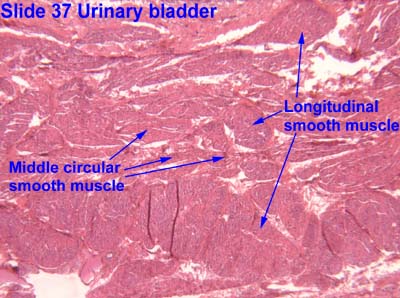
 #38.) Harry was pondering an exam question that said, "What muscle type has elongated cells and is found in the walls of the urinary bladder?" What should he have responded? 

The type of muscle that has elongated cells and is found in the walls of the urinary bladder is the smooth muscle. Smooth muscles are found in many areas of the body, including the urinary tract, reproductive, and digestive system. Smooth muscles are composed of elongated, spindle shaped cells.  Smooth muscles in the bladder are in three layers, facing in different directions for strength. They allow the bladder to expand as more urine enters it, and they gently contract to aid urination when the bladder is voided.


Work cited:
 "skeletal muscles". Video. Encyclopædia Britannica Online. Web. 21 Sep. 2013. <http://www.britannica.com/EBchecked/media/153042/Skeletal-muscles-are-attached-to-the-bones-by-tendons>


Tuesday, September 10, 2013

Axial Skeleton and Appendicular skeleton


The Axial skeleton, the bones that form the longitudinal axis of the body and consists of 80 bones (centrally located). These include the skull (cranial and facial bones), hyoid bone, veritable column (Spine or backbone), sternum and ribs.

Four specific bones in the axial skeleton: Frontal bone, inferior nasal conchae, hyoid bone and vomer.

The appendicular skeleton is the part of the skeleton that includes the pectoral girdle and the pelvic girdle and the upper and lower limbs and consists of 126 bones. Primarily comprised of bones and is held together with ligaments, with cartilage as the connective tissue.

Four specific bones in the appendicular: Femur bones, Scapulae, Humerus and ishium.

Vocabulary

Epicondyle - A rounded projection at the end of a bone, located on or above a condyle and usually serving as a place of attachment for ligaments and tendons.

Facet - A small, smooth, flat surface, as on a bone or tooth.

Foramen- A hole or opening in a bone or between body cavities.

Fossa- A depression; often an articular surface

Process trochanter- a broad, flat process on the femur, at the upper end of its lateral surface (greater t.), or a short conical process on the posterior border of the base of its neck (lesser t.) .trochanter´ictrochanter´ian

Tubercule- A nodule or small rounded process.